
Therapist vs Life Coach: What’s the Difference?
People often ask me about the difference between a therapist and a life coach.
It's a good question.
From the outside, the work can look very similar. Two people sitting together. Talking about a life. Trying to understand what is happening and what needs to change.
But they are not the same.
The short answer is this.
Therapy helps people heal psychological distress, mental illness, trauma, addiction, grief, and other challenges that affect emotional well-being.
Coaching helps people who are generally functioning well but feel stuck, face important decisions, want greater clarity, or are ready to make meaningful changes in their lives.
Some people benefit from one.
Some benefit from the other.
Many people benefit from both.
It's also worth saying that no single article can capture every kind of therapy or every kind of coaching.
There are many therapeutic approaches. There are many coaching styles. Some work is highly structured. Some is deeply reflective. Some therapists coach. Some coaches borrow ideas from psychology.
So any comparison has limits.
Still, the distinction is useful.
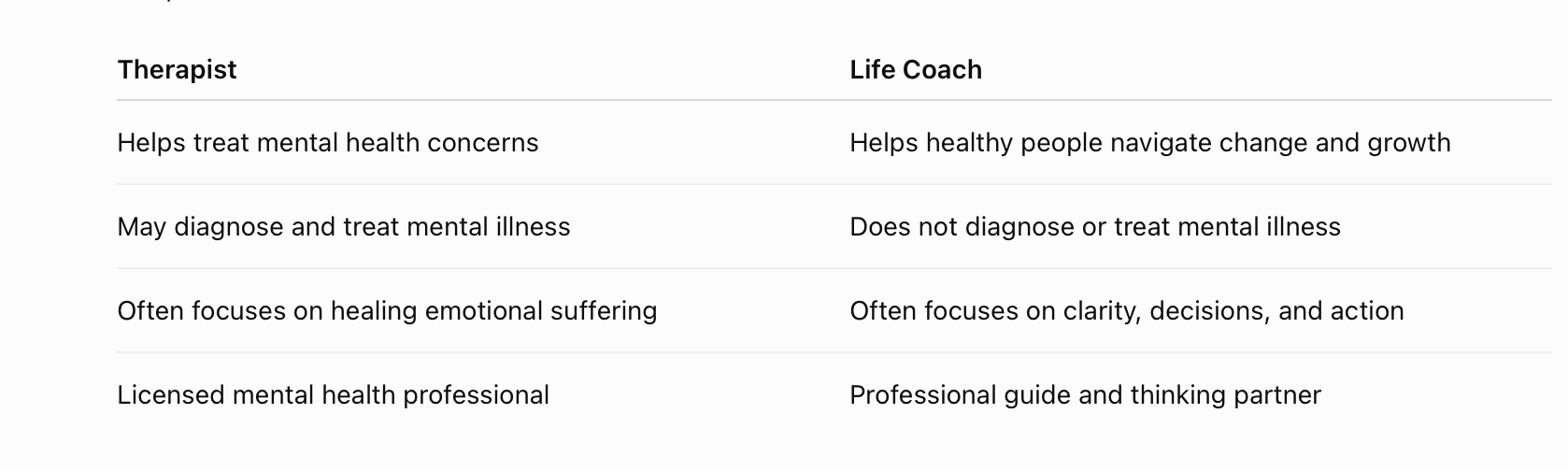
Of course, real life is rarely as neat as a table.
After twenty years of coaching, I've noticed something.
People almost never come to me asking whether they need a coach.
They say things like...
"I don't know what to do."
"Something feels off."
"Everything in my life looks fine, but I don't feel like myself anymore."
"I keep going around in circles."
They're not really asking about coaching or therapy.
They're trying to understand what kind of help they need.
That's a much more interesting conversation.
A therapist may be helping someone understand, process, or heal something that is deeply affecting their well-being.
A coach is often helping someone look honestly at the life they are living now. Their decisions. Their relationships. Their habits. Their work. The gap between the life they imagined and the one they are actually living.
That doesn't make coaching shallow.
And it doesn't mean therapy is only about the past.
Many therapists do remarkable work in the present.
Many coaches end up talking about the past because the past still shapes the present.
The boundary isn't time.
It's purpose.
Therapy is primarily concerned with healing psychological suffering.
Coaching is primarily concerned with helping someone move forward with greater awareness, clarity, and intention.
Mindfulness has an important place in that work.
Mindfulness is ancient because human difficulty is ancient.
The names change.
The technology changes.
The world changes.
But fear, longing, confusion, grief, ambition, shame, distraction, and uncertainty have been with us for a very long time.
Mindfulness isn't about escaping those experiences.
It's about learning to meet them with attention instead of reacting automatically.
That's why it belongs in coaching.
Coaching isn't only about achieving goals.
It's about learning to see more clearly.
To notice what is happening while it is happening.
To become less driven by habit and more guided by awareness.
When therapy may be the better place to begin
If you're dealing with trauma, major depression, addiction, overwhelming anxiety, panic attacks, or emotional distress that's making daily life difficult to manage, therapy is likely the better place to start.
That distinction matters.
A good coach should know where coaching ends.
If someone needs therapy, they deserve therapy.
When coaching may be the better fit
Coaching may be right if you're functioning well but feel stuck.
You may be facing an important decision.
Repeating the same pattern.
Questioning your work.
Wondering what's next.
Feeling successful on paper but strangely disconnected from your own life.
You may not need treatment.
You may need someone who can help you notice what you've been unable to see on your own.
Someone who asks the question no one else has asked.
Someone who helps you think more clearly until the next step becomes obvious.
That's often where coaching begins.
Can someone work with both?
Absolutely.
Many people do.
A therapist may help someone heal trauma, anxiety, grief, or depression.
A coach may help that same person make decisions, build healthier habits, strengthen relationships, or create a more meaningful future.
These are different kinds of help.
Sometimes both are exactly what someone needs.
What matters most
In the end, the question isn't simply:
"Should I choose a therapist or a life coach?"
The better question is:
"What kind of help do I need right now?"
If you're carrying pain that's overwhelming your ability to function, start with a therapist.
If you're trying to navigate change, make an important decision, stop repeating the same patterns, or build a life that feels more aligned with who you are becoming, coaching may be the right place to begin.
And if you're not sure...
That's okay.
You don't have to know the answer before the conversation starts.
Sometimes the first conversation isn't about deciding between therapy and coaching.
Sometimes it's about discovering what the real question is.
If you are looking for a Vancouver life coach, you can learn more about working with me here.